Matt's
EVI Gig Rig
April 2002

|
|
|
|
|
|
|
|
|
|



Matt's EVI Gig Rig - April
2002
|
Go to Matt's Gig Rig
Index
 This
page shows one of my first major wind controller gig rigs. This
rig is from April 2002. I have since had several permutations
of wind controller rigs. The link below will take you to the
master gig rig page where you can see my other previous and current
wind controller gig rigs...
This
page shows one of my first major wind controller gig rigs. This
rig is from April 2002. I have since had several permutations
of wind controller rigs. The link below will take you to the
master gig rig page where you can see my other previous and current
wind controller gig rigs...
Matt's EVI Gig Rig - April 2002
Since I am always being asked by my wind controller customers what my own rig consists of, I decided to create a page with some quality photos of my live "EVI Gig Rig" along with some notes as to how I came to choosing the components of my rig. I recently put together a "Gig Rig" for my EVI to play out with my group. Money wasn't so much an issue as the size and sound quality. The top criteria were that the rig needed to be small yet uncompromising in the sound and playability. I want to be able to load into a gig in one easy trip. Using a dolly, it is possible with this system. Fortunately, the components I chose are not necessarily the most expensive though some are hard to find. Often these items are available on the Patchman Music Used Gear page. After a lot of thought about every possible permutation, I arrived at my current rig as described on this page.
As you may know, I have extensive personal experience with
wind controllers since I program all the wind
controller soundbanks for Patchman Music. My first hand experience
programming and using so many sound modules with a wind controller
has helped me to focus on what is possible with the current crop
of synths with regards to a wind controller. 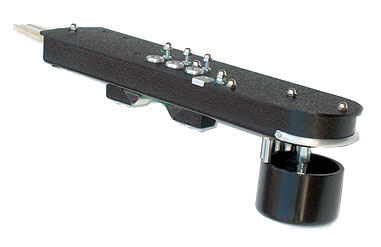 I have learned what
works best (for me at least) with a wind controller and what
to look for and avoid when deciding on wind controller gear.
Hopefully, this page will help you in your quest for your own
"Ultimate Wind Controller Gig Rig".
I have learned what
works best (for me at least) with a wind controller and what
to look for and avoid when deciding on wind controller gear.
Hopefully, this page will help you in your quest for your own
"Ultimate Wind Controller Gig Rig".
My wind controller of choice is the MIDI EVI (as shown at right). Since I am originally a trumpet player, the EVI feels most comfortable since it uses a fingering system similar to a valved brass instrument. Nyle Steiner makes the MIDI EVI by hand and it is an absolutely wonderful controller to play. You can read all about the Nyle Steiner MIDI EVI here. Learning this instrument, or any other wind controller, takes time. It took me several months to get comfortable enough with the fingering to be able to play it in public. It also takes time to get used to the mouthpiece and other controls on the instrument but the effort is well worth it. Playing a wind controller takes very little embouchure so I can sound great even after several weeks away from the instrument. Try that with a trumpet! Also, a wind controller gives a single instrumentalist the ability to emulate many different instruments. In fact, you can even sound like multiple instruments at once with the proper layered synthesizer patches. Because if this, a wind controller can open up vast possibilities for a musician who is looking to work professionally. Such versatility is a very valuable commodity. Plus, it's just a lot of fun to play!
Please note that the actual wind controller you use isn't terribly critical since most wind controllers transmit basically the same MIDI data. I use the MIDI EVI because it is currently the only choice trumpet and brass players have. There are a few other options for brass players which are detailed in the Wind Controller FAQ. There are several choices available to sax and reed players such as the Yamaha WX5, WX11, WX7, the Akai EWI series including the current model Akai EWI4000s, and the Softwind Synthophone. Patchman Music sells and supports new wind controllers and also sells a lot of used wind controllers and wind controller related synths and gear on the Patchman Music Used Gear Page.
Below is a front shot of the Matt Traum April 2002 wind controller gig rig. This rack consists of the following components: An Alesis QSR loaded with the Patchman Music QSR Volume 1 wind controller soundbank and two 8 meg Pretec Flash RAM cards, a Yamaha VL70-m Physical Modeling Sound Module with the Patchman Music VL70-m TURBO VL chip, a Boss MX-10 Ten Channel Stereo Mixer, a Boss SE-70 Super Effects Processor, and a Boss EH-50 Stereo Enhancer. Wired in the back is also a Midi Solutions Router. Below are the details on each component.
Please note that the synthesizer you use and the patches loaded in the synth are really 50% of the rig. It is critical that you choose a synth that is capable of responding properly and quickly to the MIDI data a wind controller transmits and then programming it (or buying sounds) that are specially designed for wind controller use. Some synths simply cannot be made to work well with a wind controller due to limitations in their internal patch programming capabilities and synthesis structures and processor limitations. Fortunately, a large library of professional commercial soundbanks is available from Patchman Music. Click here for a list of synthesizers that is supported by Patchman Music quality wind controller patch soundbanks.
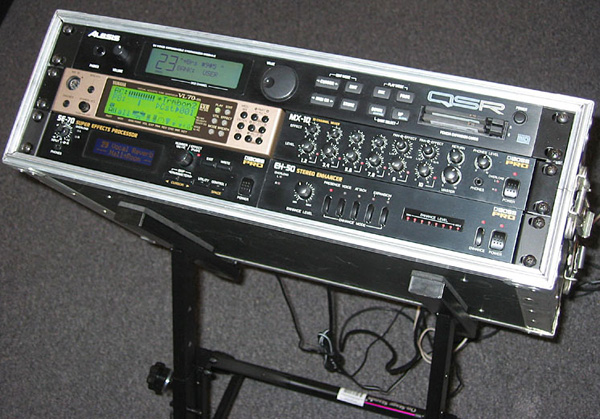
Alesis QSR Sample Playback Sound Module
The Alesis is great for several reasons. It is small- only 1 rack space. It has a great legato mode which almost no other sample playback type synth has. When programmed to play in legato, it does not retrigger the entire sample. Instead, it starts legato (slurred) notes at the sample loop point. This method works great with a wind controller. Some modules always start legato notes at the sample start point which sounds like you are tonguing each note even when you are not. Other modules smoothly stretch a sample for legato notes. But this has the problem of sounding unnatural while playing long legato melodies due to over-stretching and "munchkinization". Plus this "super-stretch method" can cause very unrealistic sound if a fingering glitch accidentally sneaks in and "super-transposes" a sample many octaves. And fingering glitches are very commonplace with every wind controller. So I have concluded that the "retrigger at the loop point" method of legato is the best. By the way, another unit that is capable of this preferred form of legato is the Kurzweil K2000 / 2500 / 2600/R series. These are superb samplers/synths and I love my K2500, but they are too bulky for my needs with this rig. In the size needed for just one K2500R I managed to fit so much more that gave me much greater versatility.
It turns out that just about all the Alesis synths use the "retrigger at the loop point" method of legato so the older single rack space Alesis S4+ is also an excellent option. In fact in some ways it may be better than the QSR. The S4+ has 4 knobs which can be programmed to do a lot of different things. Also the S4+ has a different sample ROM and some of the wind instrument samples are perhaps better. This isn't a big deal since you can use custom samples off the Flash RAM card. Of course, this is very subjective. You can compare the QSR and S4+ at the Patchman Music site. Listen to the Patchman Music QSR wind controller soundbank demo here. Listen to the Patchman Music S4+ wind controller soundbank demo here. The DISadvantage of the older S4+ module is that it has only one card slot and it has no headphone jack on the front.
My QSR has two 8 meg Pretec Flash RAM cards. (Specifically these are Linear Flash memory cards FAD008-P "8MB AMD Series D Flash" from www.pretec.com) These cards each can hold up to 8 megs of data. The data can be samples (in SampleCell format), Program banks, and Standard Midifiles. Data is loaded onto them via the free Alesis Soundbridge software. The cards are non-volatile- they have no back-up battery to go dead on you in the middle of the gig. I expect they will prove to be reliable. So far they have. And since they can store everything, you could travel light. Just take your card with you and plug it into any QSR.
Also, the Alesis is one of the few synths that can have each element in a single patch set to either mono or poly independently of each other! This is great for adding note to note transients such as pad or valve clicks that re-attack for each note while the main sound plays smoothly in mono legato. Or you might add a non-transposing picking click or body resonance to a guitar sound for added realism. Being able to add these little quirky noises and resonances in the Alesis patches allows a form of "physical modeling sample playback" if you will.
The QSR can also play back Standard Midifiles into its own synth engine so you could use this feature to play sequences within the QSR and jam over them on the VL70-m. Great fun!
Yamaha VL70-m Physical Modeling Sound Module
There is nothing like playing a VL Physical Modeling synth with quality patches with a wind controller. The VL is just a monophonic module (more precisely, stereo but with one note of polyphony), but when layered with the QSR it adds a great deal of reality to the sound. Of course it sounds great solo as well. One limitation of the VL70-m is its small Custom bank size- just 6 fully user editable Voices. But this is overcome by installing the Patchman Music TURBO VL upgrade chip which has 256 high quality wind controller patches ready to play.
Boss MX-10 10 Channel Mixer
The Boss MX-10 is the smallest rack mount mixer I know of. Unfortunately it is no longer in production and is quite hard to find. It handles 10 inputs (4 stereo line inputs, and 2 mono line or Mic inputs). It has an effects send which is wired to feed the Boss SE-70. I use one of the Mic inputs to plug my AKG C419 Clip On Trumpet Mic into. Then I can use the SE-70 for acoustic trumpet and flugelhorn as well. The output of the MX-10 goes directly into the Boss EH-50.
Boss SE-70 Super Effects Processor
The Boss SE-70 is an amazing device. Aside from great sounding reverbs, delays, etc..., it has several effects that are not commonly found on other effects processors. It has 2 vocoders, a guitar synth, bass synth, (these synths can track any mono acoustic instrument complete with a dynamic enveloped filter and amp envelope!), a tuner, a 60 cycle hum remover, a vocal remover, TRUE stereo reverbs (stereo in and out), great sounding distortions and pitch shifters, a 20(!) tap delay, 16 stage chorus, 40 stage phaser, a sampler, and on and on. It can chain a large amount of effects for massive processing. It can respond to MIDI controllers and up to 3 pedals. It's a pretty cool device. It is capable of doing all sorts of things to your sounds. The guitar and bass synths algorithms can be used with the acoustic trumpet or flugelhorn as pitch-tracking synthesizers! That's right, this thing will track your horn and synthesize it (internally only- it doesn't do pitch to MIDI conversion). It sounds great!
Boss EH-50 Stereo Enhancer
The Boss EH-50 Stereo Enhancer adds that extra sizzle to your sound without resorting to strident, ear-fatiguing eq. It responds dynamically to the audio signal. I don't use an EQ. I prefer the enhancer over EQ because it kicks in dynamically whereas an EQ is "in" fully all the time which can get tiring on the old lobes after a while. It's interesting that after working with it on for a while how dull everything sounds when you bypass it. In a way, with wind controllers, a dynamic enhancer is very similar in function to what is happening in the wind controller patches anyway. That is, the louder you play the brighter the sound. It's pretty natural and it's just adding to what is already supposed to happen with an acoustic horn anyway. The combination of the two (quality wind controller patches and the EH-50) just gives that extra dynamic punch. BTW, The Boss EH-50 is the only half rack enhancer I know of. Yes BBE makes the small unit but it isn't totally rack friendly and Alesis makes the 1/3 rack-sized Micro Enhancer which also works very well.
Anvil 3 Space "Forge II" Rack
A super heavy duty 3 space rack case. This one is about as small as you can get for 3 rack spaces yet it is built like a tank.
On-Stage Stands Rack Stand Model OSS RS7000B
This is my solution to getting the rack up high enough for easy access while playing. I believe this stand was designed for holding a small guitar amp. But I turned the two rails 180 degrees and use it as a rack stand. It's a great way to go. Since I can easily get to the rack without having to stoop down, I am eliminating the need to have a foot controller. A foot controller is still an option, but for the sake of size, I am trying to live without one for the time being.
Below is a rear shot of Matt Traum's April 2002 EVI Gig Rig. You will notice it looks pretty clean. This is partially due to the fact that I used three 1-foot Hosa brand MIDI cables and all the audio cables are only as long as they need to be. Most are only about a foot long.

Midi Solutions Router
Wired in the back is also a Midi Solutions Router. The Midi Solutions Router is used for two purposes...
First, I programmed it to filter out (block) Program Changes from getting to the VL70-m. I like to use Program Changes to select sounds on the QSR only. I select VL70-m sounds by hand as needed. Unlike most other synths, there is no Program Change reception filter on the VL70-m.
Also I programmed the Router to block MIDI Controller #65 (Portamento Switch / Pedal) from getting to the VL70-m. The MIDI EVI, Akai EWI3000 and EWI3020, as well as an EVI from EWI conversion by Nyle Steiner all send MIDI Controller #65. If the VL70-m receives a 0 value of MIDI Controller #65 it switches to Poly retriggering even if the patch was programmed to be mono-triggering. This causes the VL70-m to play very "choppy". Once this happens, the only way to regain a smooth legato is to re-select the Voice or re-edit the VL70-m Voice from the front panel (set the "Porta Sw" parameter to "on") EACH TIME after you access your Portamento sensor. Obviously these two options are impractical so I opted for using the Router to filter the offending data. BTW, the Akai EVI1000, EWI1000, EWI4000s, and all Yamaha WX wind controllers do not cause this problem with the VL70-m. Also the VL1 and VL1-m are devoid of this problem entirely.
Here is a Midifile that you can play into your Midi Solutions Router to set it up to do the things mentioned above. It is best to use a MIDI sequencer to play this file.
The Router is also great because it needs no batteries. It just hangs in there and does its job.
Wiring Description
MIDI
My MIDI EVI's MIDI OUT connects to the QSR MIDI IN, the QSR MIDI OUT (not THRU) is connected to the ROUTER IN. The Router MIDI OUT 1 is connected to the VL70-m MIDI IN, and the Router MIDI OUT 2 is connected to the SE-70 MIDI IN. I have since added a Midi Jet Pro Wireless MIDI System.
AUDIO
Pretty standard here. Stereo outs from the QSR and VL70-m go to the MX-10. The MX-10 Effects Send goes to the Left/Mono input of the SE-70. SE-70 Stereo outs go to the Stereo Returns on the MX-10. My AKG C419 Clip On Trumpet / Flugelhorn Mic goes into one of the MX-10 Mic Inputs. The Stereo Outs from the MX-10 go to the Stereo Ins on the EH-50. The Stereo Outs from the EH-50 go to the main band PA. I can use the Headphone jack on the front of the MX-10 as the feed to my Yamaha MS60 personal monitor. The Headphone level knob on the MX-10 controls the volume only to my monitor.
Yamaha MS60S Powered Monitor
This is a great, small amp for use with a wind controller- though it is no longer in production. It has a powerful full range sound yet it is small. I have two for stereo if the situation calls for it. It's been seriously used on a number of gigs as you can see.

Custom Dual MIDI EVI Hard Case
I modified this camera case to hold two MIDI EVI's plus cords etc... I can also pull out the lower foam section and put a half-rack module such as the VL70-m in it in addition to the two MIDI EVIs. The case is labelled "Travel Master by Southern Case". I pulled the original lining out and glued in foam pieces I cut.


Yamaha Dual Hard Case
This is a stock Yamaha dual hard case that holds my Trumpet and Flugelhorn, mutes and accessories. Nothing special here except that everything is in it including stands for the two horns.


K & M Flugelhorn and Trumpet Stands
These stands are great because they fit inside the bell of their respective horns. No extra baggage here.

Compact Mic Stand
I'm not sure who makes this mic stand. It was purchased at Guitar Center. It is super small yet extends to the size of a standard mic stand.

On-Stage Stands Conductor's Music Stand
This is a compact music stand that is small yet able to hold the large music books that bands often use. Much better than a flimsy wire stand.

PATCHMAN MUSIC HOME | Wind Controller Soundbanks
 |
Be sure to check out the amazing Aerophone Academy Podcast co-hosted by Patchman Music's own Matt Traum and Alistair Parnell (iSax Academy) for in depth discussions and interviews on everything related to wind controllers! |



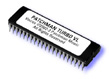 |
 Check out the INCREDIBLE PATCHMAN TURBO VL Upgrade Chip for the Yamaha VL70-m |

This page was last updated Wednesday, August 6, 2025
Copyright ©1996-2025 PATCHMAN MUSIC, LLC, All Rights Reserved
Purchase Terms and Conditions
All trademarks are property of their respective holders